Multicultural Australia
As an international student, you are a major asset to the Australian community. Not only do you contribute to a vibrant community in terms of your cultural heritage, you are contributing to one of Australia’s 4th largest exports (and hence economic prosperity).
Melbourne has c. 3.2 million people, including between 110-140 ethnicities (did you know that Melbourne is the third largest Greek city in the world, and/or it is the second largest Italian city outside of Italy?). Indeed, Australia is currently one of the most multi-cultural societies in the world. In terms of languages spoken, over 300 are spoken in homes, and although english is dominant, at least 21% of Australians speak a language other than english at home (ABS, 2016). Although numerous religious traditions are evident in Australia, Christian traditions are the most prominent, although non-Christian (and non-religious) groups have been increasing steadily over the last few decades (ABS, 2016).
You can learn more about the history of Australia and its multicultural composition by visiting the Immigration Museum. You can also check out this webpage on immigration from SBS Australia. You are also encouraged to visit the SBS website to find television/movie and radio content relating to your ethnicity.
For matters relating to discrimination involving ethnicity or religion, please see the equal opportunity page here.
Indigenous Australia
Indigenous Australians and Torres Straight Islanders make up c. 649,200 people (2.8% of total population; ABS, 2016). Indigenous Aboriginals are the original inhabitants of Australia, whilst Torres Strait Islanders are the original inhabitants of Torres Strait, making up c. 5% of the total indigenous population. Below you can see an image outlining the Torres Strait and languages spoken. Indigenous Australians have a long and extensive history with this land, as current scientific evidence suggests they have been in Australia for at least 50,000 years. They are the world’s longest continuing living culture, and should be celebrated as such.
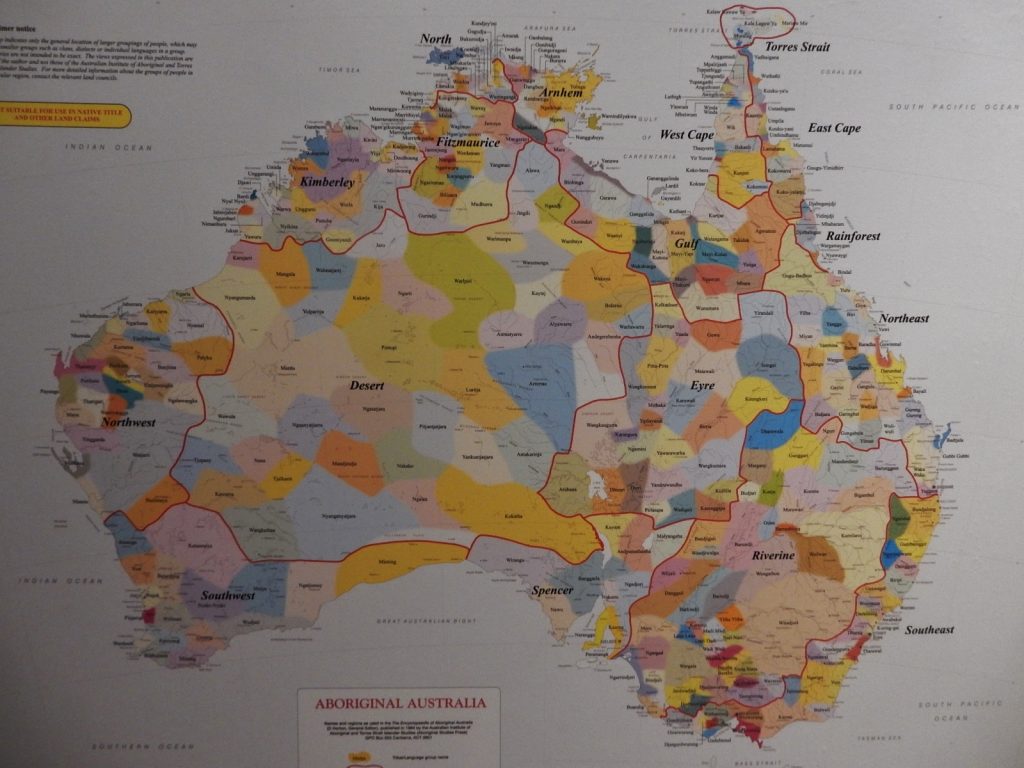
Image from Michael Coghlan (https://www.flickr.com/photos/mikecogh/43658005510).
The language map above highlights an important factor: as with any cultural group, there are important variations within. Indigenous people within Australia are no exception; they spoke different languages, had different ecological challenges, and different political systems (e.g., ). The traditional owners of the region involving Melbourne (and south central Victoria more broadly) are known as the Kulin Nation, and within this, Cairnmillar’s main campus is situated upon the traditional lands of the Wurundjeri people. Nonetheless, despite these differences within Indigenous Australian societies, some common themes do emerge: their intense relationship with the land, reference to The Dreaming, and strong ties to kin (including past ancestors). Unfortunately, another binding factor is the history involving colonisation beginning in the late 18th century, leading to numerous traumatic experiences, including the dispossession of traditional lands, loss of languages, and the Stolen Generation. Such factors, despite their rich cultural heritage and resilience, have resulted in continuing social, economic, and health challenges for Indigenous Australians.
The crucial importance of re-empowering Indigenous Australians is partly reflected in the need for educational institutes such as Cairnmillar to provide appropriate cultural training. This is now a compulsory component that all students must complete at the start of their studies at Cairnmillar. All units in all courses are now also expected to ensure that students consider the potential relevance of the material covered in relation to Indigenous Australians.
You can learn about the Indigenous history of the Yarra region (i.e., the Wurundjeri) here. If you’re interested in accessing and visiting Koori peoples for education services, exhibitions, or walking tours, visit the Koori Heritage Trust website. You can also do the same by visiting the Wurundjeri website here.
You can watch an Indigenous perspective on the history of relations between Indigenous people and European colonisers at the First Australians website. The Melbourne Museum has wonderful Indigenous exhibitions (the Bunjilaka Aboriginal Cultural Centre) and also have resources discussing the dark side of European colonisation, which you can watch here. Finally, you can learn about various aspects of Indigenous culture, again from an insider’s point of view, by visiting the Share Our Pride website, which has a wonderful resource on the issue of Aboriginal identity.
As psychologists and counsellors in training, you can also find various resources relating to your profession-to-be by visiting the Australian Indigenous Psychology Education Project (AIPEP) website.